Disability insurance is one of the most important yet often misunderstood forms of financial protection. While many people carefully insure their homes, cars, and even smartphones, far fewer consider what would happen if they suddenly became unable to work due to illness or injury. Disability insurance coverage and income protection are designed to solve exactly this problem—replacing a portion of your income when you are unable to earn it.
In this guide, we will explain how disability insurance works, what it covers, the types of policies available, how much income protection you may need, and why it is becoming increasingly essential in today’s uncertain economic environment.
What Is Disability Insurance?
Disability insurance is a type of coverage that replaces a percentage of your income if you become unable to work due to a qualifying disability. A disability can be caused by:
- Serious illness (cancer, stroke, heart disease)
- Accidents or injuries
- Chronic conditions (back pain, neurological disorders)
- Mental health conditions (in some policies)
The core purpose is simple: to protect your income when your ability to work is compromised.
Without this protection, even a temporary disability could lead to financial hardship, missed mortgage payments, debt accumulation, and long-term financial instability.
How Disability Insurance Coverage Works
Disability insurance works by paying you a monthly benefit when you meet the policy’s definition of disability. Most policies replace between 40% and 70% of your pre-disability income.
Key stages of coverage:
- You become disabled
A medical condition prevents you from performing your job duties. - You file a claim
You submit medical documentation and proof of income. - Waiting period (elimination period)
This is usually 30 to 180 days before benefits begin. - Benefit payments begin
You receive monthly income replacement until recovery or policy expiration.
This structure ensures that disability insurance acts as a financial safety net during periods of lost income.
Types of Disability Insurance
There are two main types of disability insurance coverage:
1. Short-Term Disability Insurance (STD)
Short-term disability typically covers temporary conditions.
- Coverage duration: 3 to 6 months (sometimes up to 1 year)
- Waiting period: 0 to 14 days
- Benefit: 50%–70% of income
It is commonly used for:
- Pregnancy recovery
- Minor surgeries
- Short-term injuries
2. Long-Term Disability Insurance (LTD)
Long-term disability provides extended income protection.
- Coverage duration: 2 years to retirement age
- Waiting period: 30 to 180 days
- Benefit: 40%–60% of income
It applies to:
- Serious illnesses
- Permanent injuries
- Chronic conditions
LTD is the most important form of protection for long-term financial security.
What Does Disability Insurance Cover?
Disability insurance typically covers a wide range of conditions that prevent you from working.
Covered conditions may include:
- Cancer treatments and recovery
- Heart attacks and cardiovascular diseases
- Stroke and neurological disorders
- Severe musculoskeletal injuries
- Mental health conditions (depending on policy)
- Chronic fatigue or autoimmune diseases
However, coverage depends on policy definitions, especially whether it is:
- Own-occupation coverage (best protection)
- Any-occupation coverage (more restrictive)
Own-Occupation vs Any-Occupation Coverage
Understanding this distinction is critical.
Own-Occupation Coverage
You receive benefits if you cannot perform your specific job.
Example:
A surgeon who cannot perform surgery due to hand injury still receives benefits even if they can work in another role.
✔ More expensive
✔ Stronger protection
✔ Ideal for professionals
Any-Occupation Coverage
You only receive benefits if you cannot work in any job suited to your skills.
Example:
If you can still work in a less demanding job, you may not qualify.
✔ Cheaper
✖ More restrictive
✖ Harder to qualify for benefits
Why Income Protection Matters
Most people underestimate the financial impact of disability.
Statistics often show that:
- 1 in 4 workers will experience a disability before retirement
- Many disabilities last longer than 90 days
- Savings are often insufficient to cover long-term income loss
Without income protection, people may face:
- Debt accumulation
- Loss of home or assets
- Retirement fund depletion
- Financial dependence on family
Disability insurance acts as a critical layer of financial stability.
How Much Disability Coverage Do You Need?
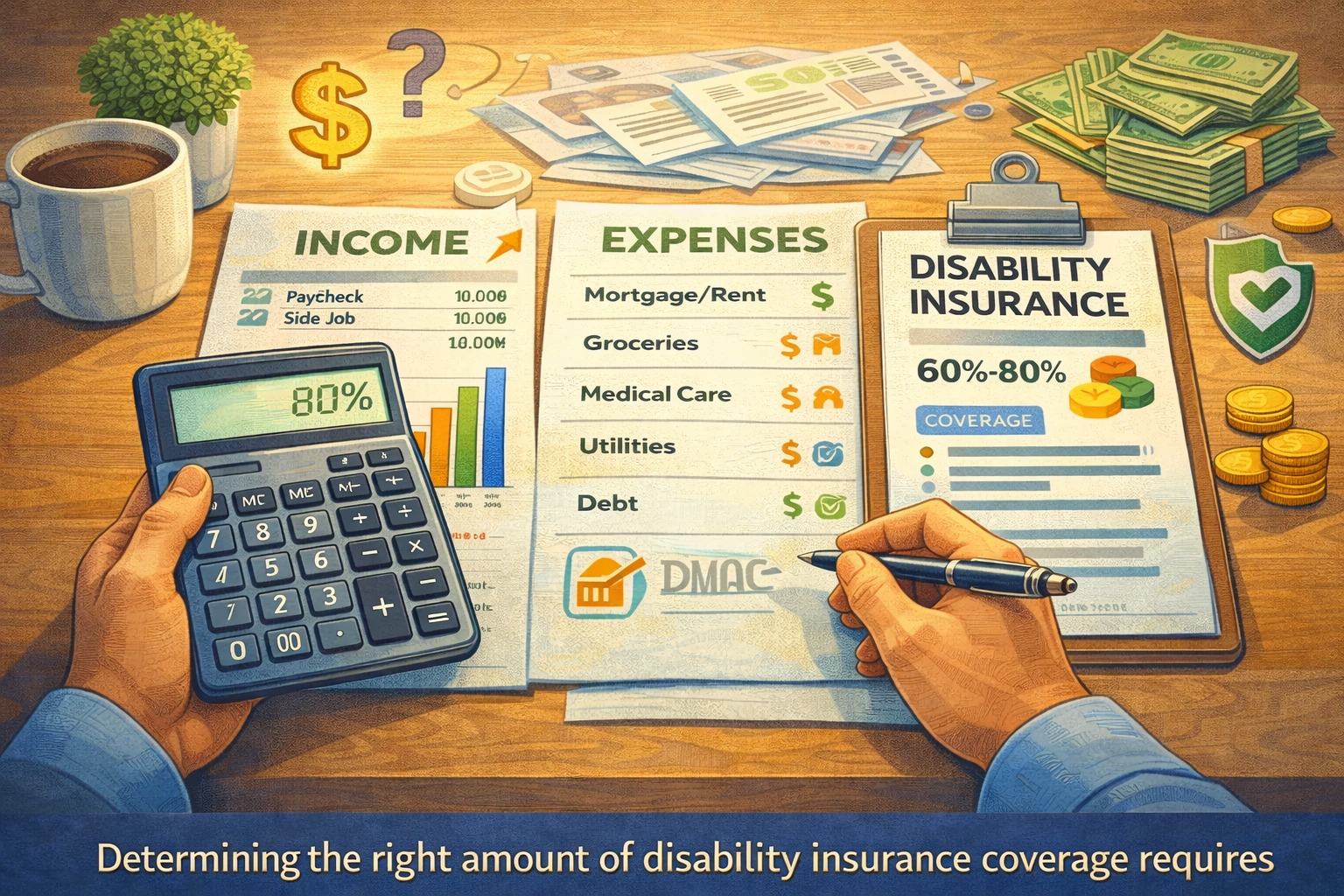
A common recommendation is to replace at least 60% of your income.
To calculate your needs, consider:
- Monthly living expenses
- Mortgage or rent
- Debt payments
- Healthcare costs
- Dependents’ needs
Example:
If you earn $5,000/month, you may need at least $3,000/month in disability benefits.
Factors That Affect Premium Costs
Disability insurance premiums vary based on several factors:
- Age (younger = cheaper)
- Occupation risk level
- Health condition
- Benefit amount
- Waiting period length
- Policy type (own vs any occupation)
High-risk jobs (construction, healthcare, manual labor) usually pay higher premiums.
Common Exclusions and Limitations
Disability insurance does not cover everything.
Common exclusions include:
- Pre-existing conditions (within certain timeframes)
- Self-inflicted injuries
- Substance abuse (in some policies)
- Injuries from illegal activities
Always review policy terms carefully before purchasing.
Employer vs Private Disability Insurance
Employer-Sponsored Plans
✔ Often cheaper or free
✖ Limited coverage
✖ Not portable if you change jobs
Private Disability Insurance
✔ Fully customizable
✔ Portable across jobs
✔ Stronger protection options
For long-term financial security, many experts recommend combining both.
The Future of Disability Insurance (2026 Trends)
The disability insurance industry is evolving with:
- Faster digital claims processing
- AI-based risk assessment
- More flexible hybrid policies
- Better mental health coverage
- Personalized income protection plans
As modern work becomes more dynamic, income protection is becoming more essential than ever.
Conclusion
Disability insurance coverage and income protection provide essential financial security when life takes an unexpected turn. Whether caused by illness or injury, losing the ability to work can have serious financial consequences.
By choosing the right policy—especially one that offers strong own-occupation coverage—you can ensure that your income, lifestyle, and long-term financial goals remain protected.
In an unpredictable world, disability insurance is not just optional coverage—it is a foundational part of a responsible financial plan.
Who Paid the Premium Decides the Tax
There is one rule and it explains every disability tax question: if the premium was paid with pre-tax dollars, the benefit is taxable; if it was paid with after-tax dollars, the benefit is tax-free. Everything else is a variation on who paid.
A 24% swing on the same benefit – worth knowing before you choose who pays.
| Who pays the premium | How it was paid | Benefit taxation | Net effect on a $6,000 benefit (24% bracket) |
|---|---|---|---|
| Employer | Pre-tax (employer deduction) | Fully taxable | $4,560 |
| You, through payroll | After-tax | Tax-free | $6,000 |
| You, through payroll | Pre-tax cafeteria plan | Fully taxable | $4,560 |
| Split 50/50 | Mixed | Prorated – roughly half taxable | $5,280 |
| You, individually | After-tax | Tax-free | $6,000 |
| Self-employed, personally paid | After-tax (not deductible) | Tax-free | $6,000 |
| S-corp paying for >2% shareholder | Pre-tax to the corporation | Taxable to the shareholder | $4,560 |
The Deductibility Trade-Off
- Individuals cannot deduct disability premiums as a personal expense. That is the price of tax-free benefits – and it is usually the better deal, because the tax saved on benefits exceeds the deduction forgone.
- Business overhead expense premiums are deductible as a business expense, and the benefits are taxable. For a business owner in a high bracket, that symmetry is roughly neutral.
- Self-employed Schedule C filers pay premiums with after-tax dollars, so benefits are tax-free, but they get no above-the-line deduction (unlike health insurance).
- S-corporation owners should be careful: if the corporation pays the premium, it is deductible to the business and taxable to the shareholder as wages.
How the Tax Changes Your Coverage Math
A 60% benefit sounds adequate until taxation is applied to both sides of the comparison:
A tax-free individual policy at 50% can beat a taxable group plan at 60%.
| Scenario | Gross income | Benefit | After tax | Replacement of take-home |
|---|---|---|---|---|
| Employer-paid plan, 60% | $10,000 | $6,000 | $4,560 | 60% of $7,600 take-home = 60% |
| Same plan + SSDI offset | $10,000 | $3,600 | $2,736 | 36% |
| Individual policy, 60% | $10,000 | $6,000 | $6,000 | 79% |
| Individual policy, 50% | $10,000 | $5,000 | $5,000 | 66% |
That is the argument for buying individual coverage even when you have a group plan: not a bigger percentage, but a better tax character and no SSDI offset.
Three Mistakes That Cost Real Money
- Choosing pre-tax payroll deduction for convenience. It feels like a discount because the premium is smaller after tax, but it converts a tax-free benefit into a taxable one.
- Forgetting state tax. Disability benefits taxable federally are usually taxable at the state level too in states with income tax, adding another 4-9% of loss.
- Assuming workers compensation is taxable. It generally is not – workers comp benefits are tax-free in every state, which changes the offset math on combined claims.
Related Guides
- Disability Insurance Income Protection for Professionals: Safeguarding Your Car…
- Individual Disability Insurance for Self Employed Professionals: Income Protect…
- Disability Insurance Coverage Guide 2026: Complete Income Protection Basics
Frequently Asked Questions
Are disability insurance benefits taxable?
Only if the premiums were paid with pre-tax dollars. Employer-paid premiums produce taxable benefits; premiums you paid with after-tax dollars produce tax-free benefits.
Should I pay my disability premium with pre-tax or after-tax dollars?
After-tax, if you can afford the slightly higher payroll deduction. It makes the benefit tax-free, which is worth 22-37% of every claim payment.
Can I deduct disability insurance premiums?
Individuals generally cannot. Business overhead expense policies are deductible as a business expense, with taxable benefits. Self-employed Schedule C filers pay with after-tax dollars and get tax-free benefits.
Are workers compensation benefits taxable?
No. Workers compensation benefits are tax-free in all states, which matters when a workers comp benefit offsets a taxable group LTD benefit.
How do I know if my group plan is employer-paid?
Ask HR whether the LTD premium is employer-paid, employee-paid after tax, or paid through a pre-tax cafeteria plan. The answer determines whether your benefit will be taxed.
Is SSDI taxable?
Often partially yes, depending on total income. Up to 85% of SSDI can be taxable above certain income thresholds, which further reduces the net value of an offset benefit.
Leave a Reply