
Introduction: High Earners Face Unique Risks
For professionals such as doctors, lawyers, engineers, and executives, income is often the most valuable asset. A temporary or long-term disability can dramatically disrupt lifestyle, family obligations, and financial goals.
Disability Insurance provides a critical safety net, ensuring that even in the event of illness or injury, your career income is protected. This article explains disability insurance income protection for professionals, why it’s essential, and how to select the right policy.
Why Professionals Need Disability Insurance
While everyone benefits from income protection, high-earning professionals face specific risks:
-
High living expenses: mortgages, tuition, and family support
-
Specialized skills: lost ability to perform a niche job has major income implications
-
Delayed recovery costs: maintaining lifestyle during rehabilitation
-
Limited group coverage: employer plans may cap benefits
Disability Insurance safeguards against these risks by replacing a portion of income, maintaining financial stability, and allowing focus on recovery without financial stress.
Core Features of Professional Disability Income Protection
Professional Disability Insurance typically offers:
1. Own-Occupation Coverage
-
Pays benefits if you cannot perform your specialized role
-
Critical for surgeons, attorneys, architects, and executives
-
Protects income even if you can work in another capacity
2. High Monthly Benefit Caps
-
Covers significant portions of high income
-
Supplements employer-provided plans
-
Prevents financial strain during extended disability
3. Long-Term Benefit Periods
-
Often extends to retirement age (65–67)
-
Ensures long-term financial security
-
Protects against permanent disabilities
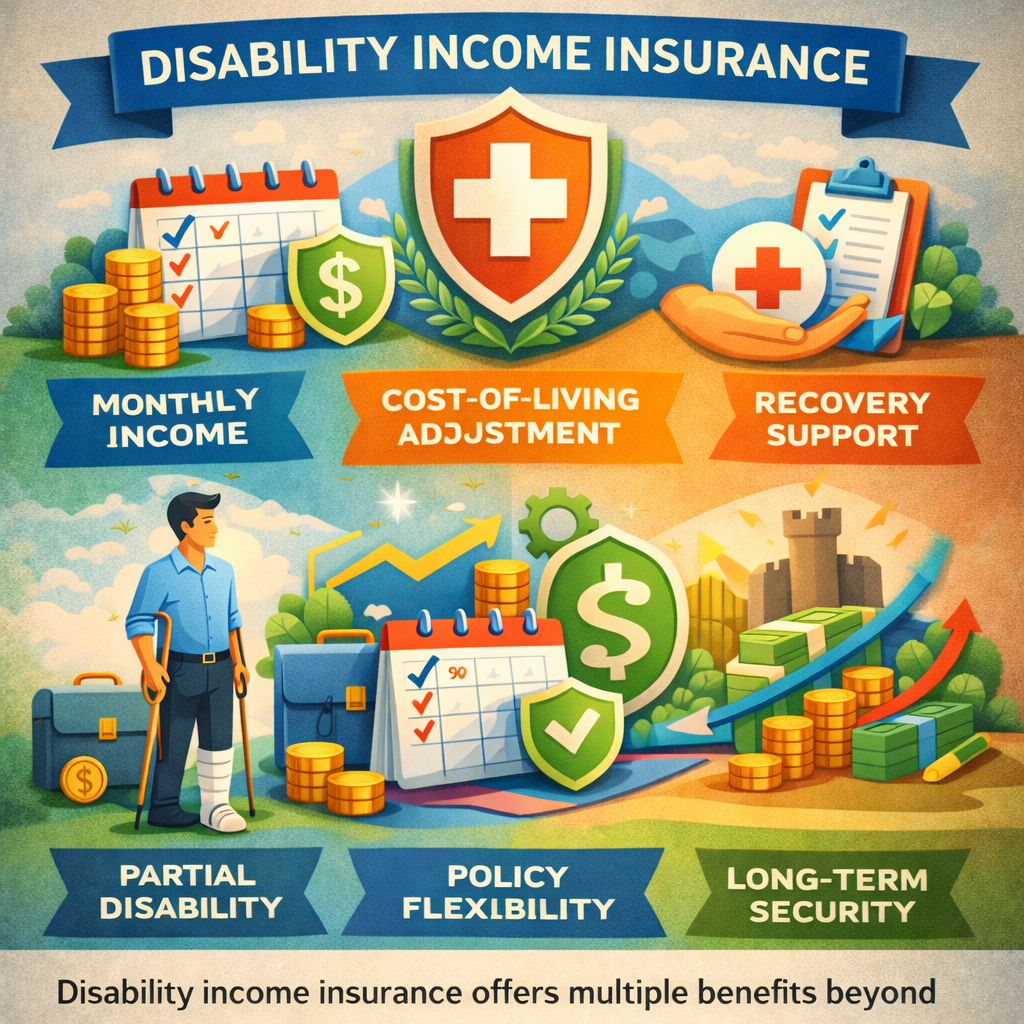
4. Cost-of-Living Adjustments (COLA)
-
Maintains purchasing power during prolonged disability
-
Protects against inflation eroding benefits
5. Residual or Partial Disability Benefits
-
Provides support if partial work is possible
-
Encourages rehabilitation while preserving financial stability
Evaluating Professional Coverage Needs
When choosing professional Disability Insurance, consider:
-
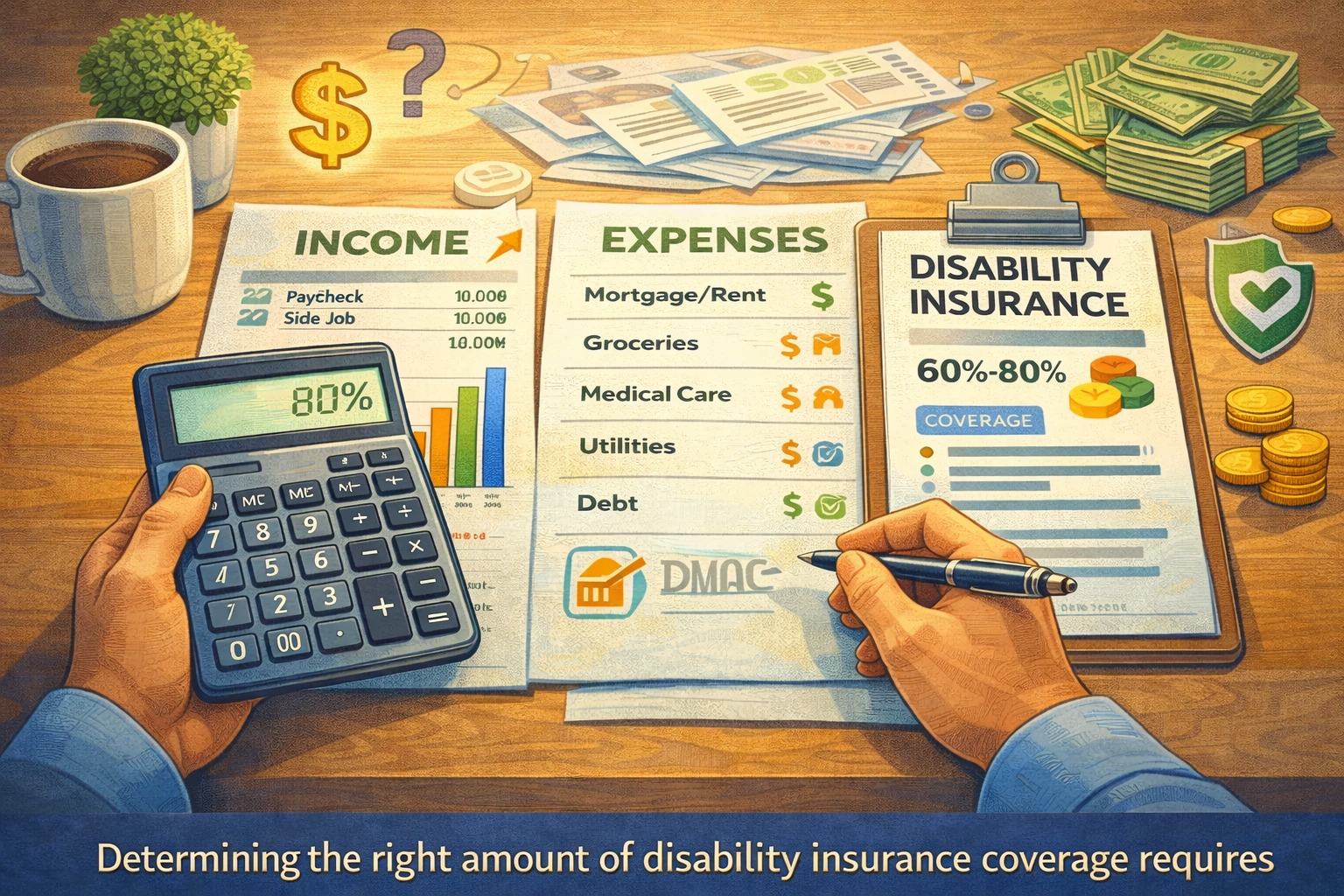
Income replacement ratio: typically 50–70%
-
Benefit limits: ensure caps cover high earnings
-
Waiting period: balance affordability and immediate income needs
-
Policy portability: maintain coverage across job changes
-
Exclusions: review conditions not covered
Proper evaluation ensures coverage aligns with both career risks and financial obligations.
Tax Considerations for Professionals
Tax treatment affects net replacement income:
-
Employer-paid premiums: benefits often taxable
-
Individually purchased, after-tax premiums: benefits typically tax-free
Professional clients should evaluate tax implications when structuring policies, especially if high-income levels are involved.
Real-World Examples: Protecting Professional Income
Example 1: Surgeon
-
Annual income: $300,000
-
Employer LTD: $15,000/month
-
Individual Disability Insurance supplements coverage to $20,000/month
-
Own-occupation policy ensures benefits continue despite inability to perform surgeries
Example 2: Attorney
-
Solo practitioner earning $180,000/year
-
Disability prevents client work for 9 months
-
Individual policy replaces 60% of income, covering mortgage, staff salaries, and business expenses
These examples highlight the importance of tailored policies for professionals.
Integration With Financial Planning
Disability Insurance for professionals is most effective when integrated into broader financial planning:
-
Emergency funds cover initial waiting periods
-
Life insurance protects dependents
-
Retirement plans remain intact during disability
-
Business overhead coverage protects practice or firm continuity
This integrated approach ensures comprehensive protection.
Common Mistakes Professionals Make
-
Relying solely on employer-sponsored coverage
-
Assuming standard group policies meet high-income needs
-
Ignoring waiting periods and benefit caps
-
Delaying coverage purchase until later in career
Early, proactive planning ensures financial resilience against disability.
Selecting the Right Policy
When selecting a professional Disability Insurance policy:
-
Prioritize own-occupation definitions
-
Ensure benefit caps match income level
-
Evaluate waiting periods against savings
-
Consider policy portability for career flexibility
-
Include optional riders like COLA and residual benefits
Choosing wisely maximizes both coverage and affordability.
Key Takeaways
-
Professionals face higher financial risk from disability
-
Disability Insurance protects high-income careers and lifestyle
-
Own-occupation coverage and supplemental policies are essential
-
Waiting periods, benefit caps, and COLA affect real-world protection
-
Integration with overall financial planning ensures long-term security
Conclusion
Disability insurance income protection for professionals is not optional—it is essential. Income is a professional’s greatest asset, and losing it unexpectedly can have lasting consequences.
By understanding coverage features, benefit limits, and policy design, professionals can secure reliable income replacement, safeguard their careers, and maintain financial stability—even in the face of serious illness or injury.
Disability Insurance is more than a safety net; it is a strategic tool for protecting both professional success and personal well-being.
Why “Professional” Changes the Contract
Two policyholders with identical incomes can pay very different premiums and receive very different benefits, because insurers price professionals by the economic value of their specific skill set. The classification is not vanity – it is actuarial.
Occupation class moves the premium 100-250% for the same benefit amount.
| Profession | Typical occupation class | Own-occ availability | Why |
|---|---|---|---|
| Surgeon / interventional specialist | 5-6 (best) | Usually to 65 | Precision skills, high replacement cost, low claim duration |
| Dentist | 5 | To 65 with riders | Hand-intensive; back and wrist claims common |
| Attorney / CPA | 4-5 | To 65 | Cognitive; mental health claims scrutinized |
| Architect / engineer | 4 | To 65 | Mix of cognitive and site work |
| Pharmacist | 3-4 | 2-5 years | Standing work, lower pricing tier |
| Chiropractor / physical therapist | 3 | 2-5 years | Physical demands raise claim frequency |
What High Earners Actually Need Beyond the Base Policy
The riders are where professional policies differ from commodity DI.
| Feature | Why it matters above $150,000 income | Typical cost |
|---|---|---|
| Higher issue limits / multi-carrier stacking | One carrier caps at $8,000-$12,500 a month | +15-25% total premium |
| COLA rider | A $10,000 benefit at 60 becomes $6,200 of purchasing power in 12 years | +15-25% |
| Future purchase option | Lets you raise coverage with income without new underwriting | +5-10% |
| Residual disability | Covers the 40-60% income loss that follows most serious claims | +10-20% |
| Catastrophic rider | Adds a lump sum for severe, permanent disability | +3-8% |
| Retirement protection rider | Funds retirement contributions while on claim | +10-20% |
Employer Plans and the Offset Trap for Professionals
A hospital or law firm group plan usually looks generous – 60% of base, employer-paid. Three mechanics turn that 60% into far less:
- The cap. Group LTD frequently caps at $5,000-$8,000 a month. At $300,000 of income, that is a 20-30% replacement, not 60%.
- Taxability. Employer-paid premiums make benefits taxable, cutting the net benefit by 25-37% for high earners.
- Bonus exclusion. Professional income often includes bonuses, partnership distributions and incentive comp – none of which the group plan insures.
The result is a coverage gap that grows with income. A $400,000 surgeon with a $7,500 capped group plan has roughly 22% of gross income insured – the reason individual own-occupation coverage exists in this market.
What to Ask Before You Sign
- “Is the own-occupation definition to age 65, or does it switch to any-occupation at 24 months?”
- “Are my bonuses and partnership distributions insurable, and how are they averaged?”
- “Does the policy offset group LTD, and in what order?”
- “Is there a mental-health or musculoskeletal limitation, and how long does it apply?”
- “Can I exercise a future purchase option after a raise without a new exam?”
- “What is the exact wording of the residual benefit trigger?”
Frequently Asked Questions
Do professionals pay less for disability insurance?
Yes – occupation class 5-6 professions often pay 30-50% less than class 3 for the same benefit, because claim frequency and duration are lower. It is one of the few genuine discounts in the product.
Is own-occupation coverage worth the extra premium for a specialist?
For surgeons, dentists and other skill-specific professionals, yes. A 40% premium increase buys a definition that pays when you cannot perform your specialty, which is the scenario that actually happens.
My employer provides 60% of base salary. Why do I need more?
Because group plans cap monthly benefits, exclude bonuses and are taxable when employer-paid. High earners often end up with 20-35% of real income replaced, not 60%.
Are bonuses and commissions insurable?
Often yes, if documented over two to three years and specifically underwritten. Many group plans ignore them entirely, which is a common and expensive gap for professionals.
What is a residual disability benefit?
It pays a proportional benefit when you return to work at reduced hours or income – typically covering 50-80% of the income loss. For professionals, most serious claims end as residual claims, not total ones.
How long does underwriting take for a professional policy?
Typically four to eight weeks, longer for high limits or complex income. Expect requests for tax returns, a financial statement and sometimes a paramedical exam.

Leave a Reply