
Introduction: Why Coverage Duration Matters
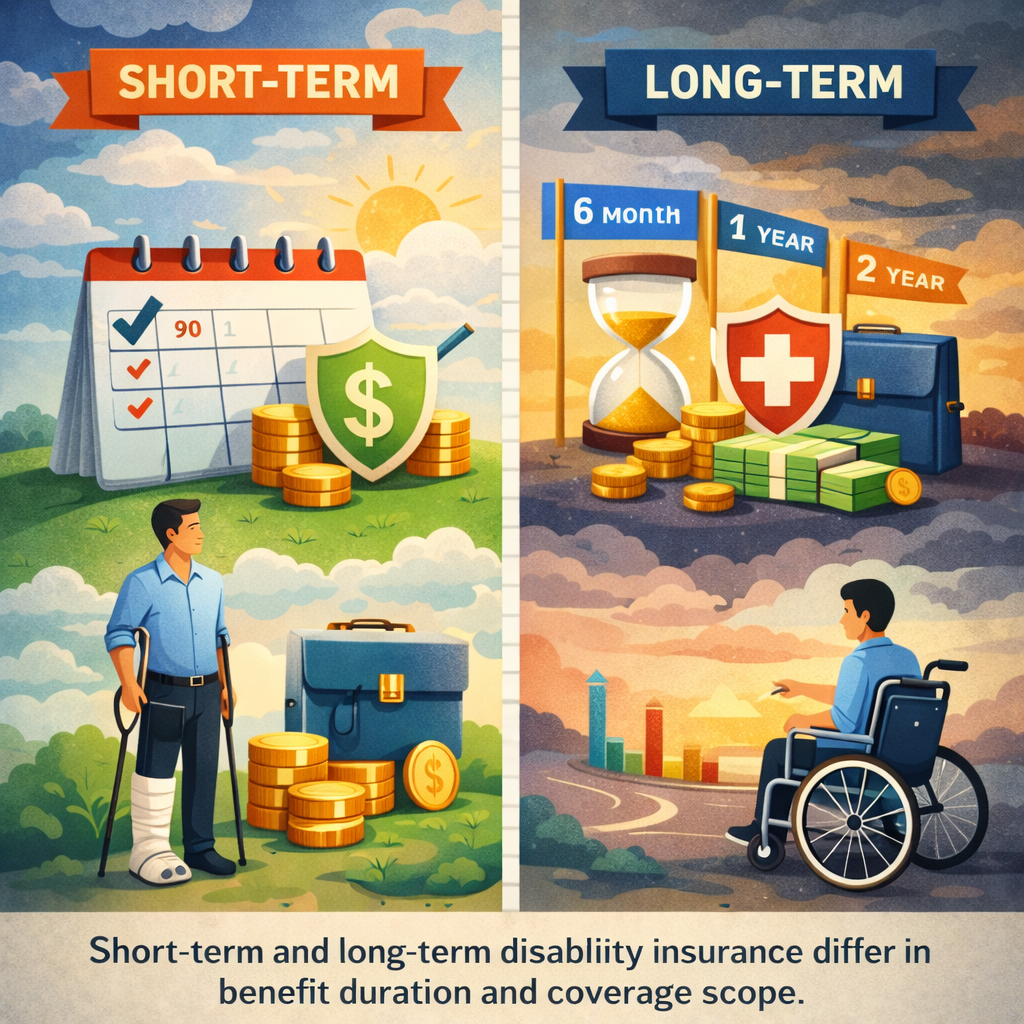
A disabling illness or injury can last weeks, months, or even years. The length of time you are unable to work has a direct impact on your financial stability. This is why understanding short term vs long term disability insurance coverage is essential when evaluating income protection strategies.
Disability Insurance is not a single product but a category of coverage designed to address different stages of income loss. Short-term and long-term policies serve distinct purposes, and choosing the wrong type—or relying on only one—can leave critical gaps in protection.
This article explains how short-term and long-term Disability Insurance differ, how each functions, and how U.S. workers can determine the right coverage mix.
The Role of Disability Insurance in Income Protection
The primary role of Disability Insurance is to replace lost income when a covered disability prevents employment. However, not all disabilities are the same in duration or severity. Some resolve quickly, while others require long recovery periods or result in permanent impairment.
Disability Insurance is structured into two main categories to address these differences:
-
Short-term disability insurance (STD)
-
Long-term disability insurance (LTD)
Understanding the distinction between them is critical for effective financial planning.
What Is Short-Term Disability Insurance?
Short-term disability insurance provides income replacement for temporary disabilities that prevent work for a limited period.
Key Characteristics of Short-Term Disability Insurance
-
Benefit duration: typically 3 to 6 months, sometimes up to 12 months
-
Waiting period: often 0 to 14 days
-
Income replacement: generally 50% to 70% of earnings
-
Commonly employer-sponsored in the U.S.
Short-term Disability Insurance is designed to cover immediate income needs following surgery, injury, pregnancy, or acute illness.
What Is Long-Term Disability Insurance?
Long-term disability insurance provides income protection for extended or permanent disabilities that prevent work beyond the short-term period.
Key Characteristics of Long-Term Disability Insurance
-
Benefit duration: 2 years, 5 years, 10 years, or until retirement age
-
Waiting period: usually 90 to 180 days
-
Income replacement: typically 50% to 60% of earnings
-
Available through employers or individual policies
Long-term Disability Insurance addresses the most financially devastating scenarios, where income loss extends for years.
Short Term vs Long Term Disability Insurance Coverage Compared
Understanding short term vs long term disability insurance coverage requires comparing multiple dimensions, not just duration.
Coverage Duration
-
Short-term coverage addresses temporary income loss
-
Long-term coverage protects against prolonged or permanent disability
Waiting Periods
-
Short-term policies begin quickly
-
Long-term policies require a longer elimination period
Cost Structure
-
Short-term policies are less expensive
-
Long-term policies cost more due to extended benefit exposure
Financial Impact
-
Short-term coverage helps with immediate expenses
-
Long-term coverage preserves long-term financial stability
How Employer-Sponsored Plans Typically Work
In the U.S., many employers offer a combination of short-term and long-term Disability Insurance. While beneficial, these plans often have limitations:
-
Benefits may be taxable
-
Coverage percentages may be lower than expected
-
Definitions of disability may be restrictive
-
Coverage may end when employment ends
Employees frequently overestimate the adequacy of employer-sponsored Disability Insurance, making it important to review plan details carefully.
Individual Disability Insurance as a Supplemental Strategy
Individual Disability Insurance can supplement employer coverage by:
-
Increasing income replacement levels
-
Extending benefit duration
-
Providing stronger definitions of disability
-
Ensuring portability across career changes
High-income earners and professionals often rely on individual policies to fill gaps left by group plans.
Choosing Between Short-Term and Long-Term Coverage
Rather than choosing one over the other, many financial planners recommend a layered approach:
-
Emergency savings cover very short disruptions
-
Short-term Disability Insurance covers early income loss
-
Long-term Disability Insurance protects against catastrophic income loss
This integrated strategy creates continuous income protection across different time horizons.
Common Misconceptions About Coverage Duration
Several misconceptions can lead to inadequate coverage:
-
Believing short-term coverage is sufficient for all disabilities
-
Assuming long-term coverage starts immediately
-
Overestimating recovery speed
-
Relying solely on government disability programs
Understanding policy timelines helps avoid dangerous income gaps.
Industry Use Cases and Practical Examples
Example 1: Office Employee
An employee experiences a serious injury requiring four months of recovery. Short-term Disability Insurance provides income during this period, preventing savings depletion.
Example 2: Professional Career Disruption
A professional develops a chronic condition that prevents long-term work. Long-term Disability Insurance provides sustained income replacement, protecting retirement plans and family finances.
How Coverage Definitions Affect Benefits
Both short-term and long-term Disability Insurance rely on definitions of disability, such as:
-
Own occupation: inability to perform your specific job
-
Any occupation: inability to perform any reasonable work
Long-term policies often shift definitions over time, affecting benefit eligibility.
Why Duration Planning Is a Financial Priority
Disability duration—not just probability—determines financial impact. Short-term disruptions are manageable; long-term income loss can permanently alter financial outcomes.
Disability Insurance provides the structure needed to manage both.
Key Takeaways
-
Short-term Disability Insurance covers temporary income loss
-
Long-term Disability Insurance protects against extended disability
-
Waiting periods and benefit durations differ significantly
-
Employer coverage may not be sufficient on its own
-
A layered income protection strategy is often most effective
Conclusion
Understanding short term vs long term disability insurance coverage is essential for building a resilient income protection plan. Each type of Disability Insurance serves a distinct purpose, and together they create a comprehensive safety net against income loss.
By aligning coverage duration with financial obligations and career stage, U.S. workers can ensure continuity, stability, and long-term financial security—even when the unexpected occurs.

Leave a Reply