

Introduction: Income Loss Is the Real Financial Emergency
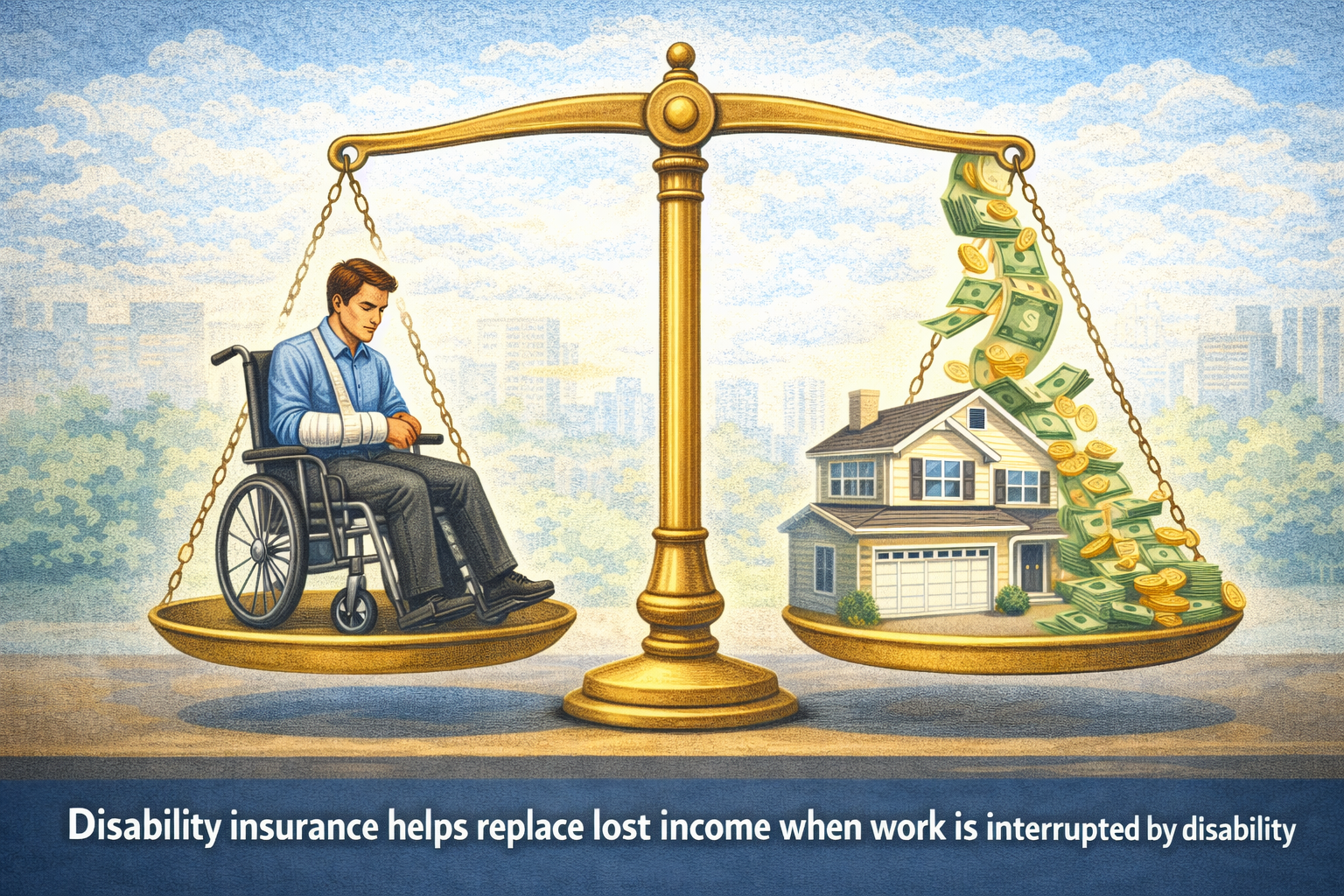
Most financial emergencies are temporary. A car repair, medical bill, or unexpected expense can often be managed with savings or credit. Income loss, however, is fundamentally different. When an illness or injury prevents you from working, the cash flow that supports every aspect of daily life can disappear overnight.
This is precisely where Disability Insurance becomes essential. Understanding how disability insurance replaces lost income is critical for evaluating whether your coverage is adequate and aligned with your financial responsibilities. This article explains the mechanics, calculations, limitations, and real-world effects of income replacement under Disability Insurance in the United States.
The Core Purpose of Disability Insurance
Disability Insurance is designed to replace a portion of earned income when a covered disability prevents you from working. Unlike emergency funds, which are finite, Disability Insurance provides structured, ongoing income support for as long as the disability meets policy requirements.
The primary objectives of Disability Insurance include:
-
Maintaining financial stability during disability
-
Preventing depletion of savings and retirement assets
-
Supporting ongoing household obligations
-
Preserving long-term financial plans
Rather than eliminating financial risk, Disability Insurance transfers that risk from the individual to the insurer.
How Disability Insurance Replaces Lost Income
To understand how disability insurance replaces lost income, it is important to examine how benefits are calculated and paid. Most U.S. policies follow a standardized framework.
Step 1: Determining Pre-Disability Earnings
Pre-disability income is typically based on:
-
Base salary or wages
-
Bonuses or commissions (subject to documentation)
-
Self-employed net income (for individual policies)
Insurers use historical earnings—often the most recent 12 to 24 months—to establish an income baseline.
Step 2: Applying the Income Replacement Ratio
Disability Insurance does not replace 100% of income. Instead, it generally replaces 50% to 70% of gross earnings. This range is intentional and serves several purposes:
-
Encourages return to work when possible
-
Accounts for reduced work-related expenses during disability
-
Prevents overinsurance and moral hazard
The exact replacement percentage depends on policy type, income level, and underwriting guidelines.
Step 3: Monthly Benefit Caps
Even when replacement percentages are high, policies impose monthly benefit limits. These caps are common in both employer-sponsored and individual Disability Insurance plans.
For example:
-
A policy may replace 60% of income up to a maximum of $8,000 per month
-
High earners may need supplemental or individual policies to close gaps
Understanding benefit caps is critical when assessing total income protection.
Step 4: Waiting Period Before Benefits Begin
Disability Insurance benefits do not start immediately. Policies include a waiting period, also known as an elimination period, which typically ranges from:
-
30 to 180 days for short-term coverage
-
90 days or longer for long-term coverage
During this time, individuals rely on savings, sick leave, or other resources. Longer waiting periods generally result in lower premiums.
Step 5: Ongoing Monthly Benefit Payments
Once the waiting period is satisfied and the disability is approved, benefits are paid monthly. Payments continue as long as:
-
The disability meets the policy definition
-
Medical documentation is maintained
-
The benefit period has not expired
Benefit periods can last from a few months to several years or even until retirement age.
The Role of Partial and Residual Disability Benefits
Many disabilities do not result in complete inability to work. Modern Disability Insurance policies often include partial or residual disability benefits.
These benefits apply when:
-
You can work in a limited capacity
-
Income is reduced due to disability
-
Recovery is gradual rather than immediate
Residual benefits are especially valuable for professionals and self-employed individuals whose income may decline rather than disappear entirely.
Tax Treatment of Disability Insurance Benefits
Taxation plays a significant role in determining net income replacement.
-
Employer-paid premiums: Benefits are usually taxable
-
Employee-paid premiums (after-tax): Benefits are typically tax-free
-
Individually owned policies: Often tax-free if paid with after-tax dollars
The tax status of benefits can significantly affect actual income replacement levels.
Coordination With Social Security Disability Insurance (SSDI)
Many people assume SSDI will fully replace lost income. In reality:
-
SSDI benefits are modest
-
Approval rates are low
-
Qualification standards are strict
-
Waiting periods are long
Some Disability Insurance policies reduce benefits by SSDI amounts, while others are designed to supplement government benefits. Understanding this coordination is essential to avoid coverage gaps.
Real-World Income Replacement Scenarios
Scenario 1: Salaried Employee
A professional earning $75,000 annually experiences a disabling illness. With a Disability Insurance policy replacing 60% of income:
-
Annual benefit: $45,000
-
Monthly benefit: $3,750
-
Core expenses remain manageable without liquidating assets
Scenario 2: High-Income Professional
A physician earning $250,000 annually faces a long-term disability. Employer coverage caps benefits at $10,000 per month, leaving a significant gap. An individual policy bridges the difference, preserving lifestyle and financial goals.
Limitations and Realistic Expectations
While Disability Insurance is powerful, it has limitations:
-
Benefits are partial, not full income replacement
-
Policies include exclusions and limitations
-
Mental health and subjective conditions may have caps
-
Documentation and compliance are required
Understanding these limitations leads to better planning and fewer surprises.
Why Understanding Income Replacement Matters
Failing to understand how disability insurance replaces lost income can result in:
-
Underestimating coverage needs
-
Overreliance on employer benefits
-
Inadequate emergency savings
-
Financial instability during disability
Education is the foundation of effective income protection planning.
Disability Insurance as a Long-Term Income Strategy
Disability Insurance should not be viewed in isolation. It interacts with:
-
Emergency savings
-
Retirement planning
-
Life insurance
-
Investment strategies
When integrated properly, it stabilizes financial plans against one of the most common and disruptive risks during working years.
Key Takeaways
-
Disability Insurance replaces a portion of lost income during disability
-
Replacement ratios typically range from 50% to 70%
-
Benefit caps and waiting periods affect total protection
-
Tax treatment influences net benefit amounts
-
Partial disability benefits provide flexible income support
-
SSDI alone is rarely sufficient
Conclusion
Understanding how disability insurance replaces lost income is essential for evaluating the effectiveness of your coverage. Disability Insurance is not simply a policy—it is a structured income replacement system designed to preserve financial stability when earning ability is compromised.
By examining benefit calculations, limitations, and real-world applications, individuals can make informed decisions and build a resilient income protection strategy that supports long-term financial security.

Leave a Reply