

Introduction: Beyond Basic Income Replacement
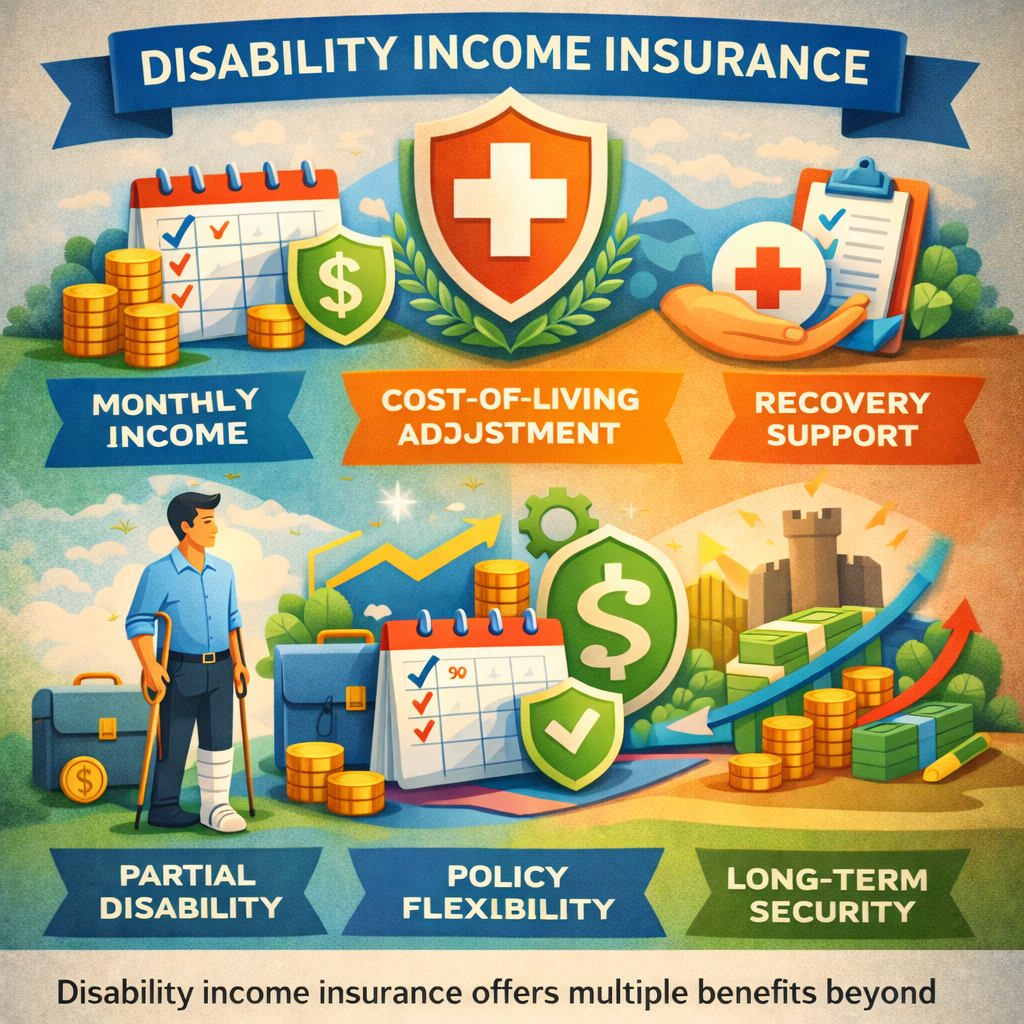
Many Americans understand that Disability Insurance replaces lost income, but few are aware of the full spectrum of benefits that modern policies provide. Understanding these benefits is critical for making informed coverage decisions and ensuring comprehensive income protection.
This article provides a detailed, professional explanation of disability income insurance benefits explained, helping U.S. workers, professionals, and self-employed individuals maximize the value of their policies.
What Are Disability Income Insurance Benefits?
Disability income insurance benefits are payments made to policyholders who are unable to work due to a covered illness or injury. While the primary function is income replacement, benefits may also include additional features designed to protect financial stability and adapt to changing circumstances.
Key aspects include:
-
Monthly income replacement
-
Short-term and long-term coverage options
-
Policy riders for specialized needs
-
Flexibility to accommodate partial or residual disability
Types of Disability Income Benefits
1. Total Disability Benefits
-
Paid when you are completely unable to perform your job duties
-
Usually calculated as a percentage of your pre-disability income (50%–70%)
-
Designed to maintain lifestyle and financial obligations during full work incapacity
2. Partial or Residual Disability Benefits
-
Provided when you can work part-time or in a reduced capacity
-
Compensates for lost income due to reduced earning ability
-
Encourages gradual recovery without full financial disruption
3. Short-Term vs Long-Term Benefits
-
Short-Term Disability (STD): covers temporary, minor disabilities, typically 3–12 months
-
Long-Term Disability (LTD): covers extended or permanent disabilities, often until retirement age
Understanding how these benefits interact is critical to comprehensive coverage.
Optional and Advanced Policy Benefits
Modern Disability Insurance policies often include additional benefits or riders:
1. Cost-of-Living Adjustments (COLA)
-
Protects benefits against inflation
-
Ensures monthly income retains purchasing power over long-term disability periods
2. Own-Occupation Coverage
-
Provides benefits if you cannot perform your specific job, even if able to work in another capacity
-
Essential for highly specialized professions
3. Future Increase Option (FIO)
-
Allows policyholder to increase coverage as income grows
-
Protects against underinsurance over time
4. Rehabilitation and Vocational Benefits
-
Supports retraining or career transitions after disability
-
Encourages return to work when medically feasible
Tax Considerations of Disability Income Insurance Benefits
Taxation affects net benefits:
-
Employer-paid premiums often result in taxable benefits
-
Individually owned, after-tax premiums typically provide tax-free benefits
-
Understanding tax implications helps accurately calculate effective income replacement
Waiting Periods and Elimination Periods
Benefits are not always immediate. Policies include waiting periods (elimination periods), which can range from:
-
14–30 days for short-term coverage
-
90–180 days for long-term coverage
During this period, income must be covered by savings, sick leave, or other resources. Some policies offer partial payments during the waiting period.
Real-World Scenarios: Maximizing Benefits
Scenario 1: Office Professional
-
A mid-level employee earns $80,000 annually
-
Disability Insurance replaces 60% of income ($48,000)
-
Policy includes residual disability benefits
-
Able to work part-time while receiving partial benefits, maintaining financial stability
Scenario 2: High-Income Specialist
-
Surgeon earning $250,000 annually
-
Group coverage caps benefits at $15,000/month
-
Individual Disability Insurance supplements coverage to maintain income level
-
Own-occupation benefits ensure full protection for specialized work
These examples illustrate how understanding policy benefits prevents financial gaps and stress.
Common Misunderstandings About Disability Income Insurance Benefits
-
Assuming policies cover all illnesses—some conditions may be excluded
-
Believing income replacement is 100%—most policies replace 50–70%
-
Overlooking policy riders that enhance protection
-
Ignoring benefit duration limitations
Awareness of these nuances ensures you select the most effective policy.
How to Evaluate Disability Income Insurance Benefits
To assess whether a policy meets your needs:
-
Review monthly income replacement percentages
-
Evaluate benefit periods and waiting periods
-
Check for optional riders (COLA, FIO, vocational)
-
Understand disability definitions (own occupation vs any occupation)
-
Calculate after-tax benefit levels
This structured approach ensures benefits align with both current and future financial needs.
Integration With Financial Planning
Disability Income Insurance should be viewed as part of a broader financial strategy, including:
-
Emergency savings
-
Health insurance
-
Retirement contributions
-
Life insurance
Proper integration maximizes protection and financial resilience.
Key Takeaways
-
Disability income insurance benefits extend beyond basic income replacement
-
Policies may include partial disability, own-occupation, COLA, and vocational benefits
-
Waiting periods and benefit durations influence protection
-
Taxation impacts effective replacement ratios
-
Real-world planning prevents gaps in income during disability
Conclusion
Understanding disability income insurance benefits explained is critical for U.S. workers and self-employed professionals who rely on their income. Beyond monthly benefit payments, modern policies offer a range of options to protect financial stability, adapt to changing circumstances, and support recovery.
By evaluating and customizing Disability Insurance benefits, individuals can build a comprehensive safety net that safeguards income, preserves lifestyle, and ensures long-term financial security—even in the face of unexpected disability.

Leave a Reply